AI in 1997: Dissecting a Virtual Fish Brain
MOPy Fish was said to have an AI brain that sulks, gets bored and remembers a week of care. The brain.dat file records when you last fed it, and not much else.
November 23, 2026
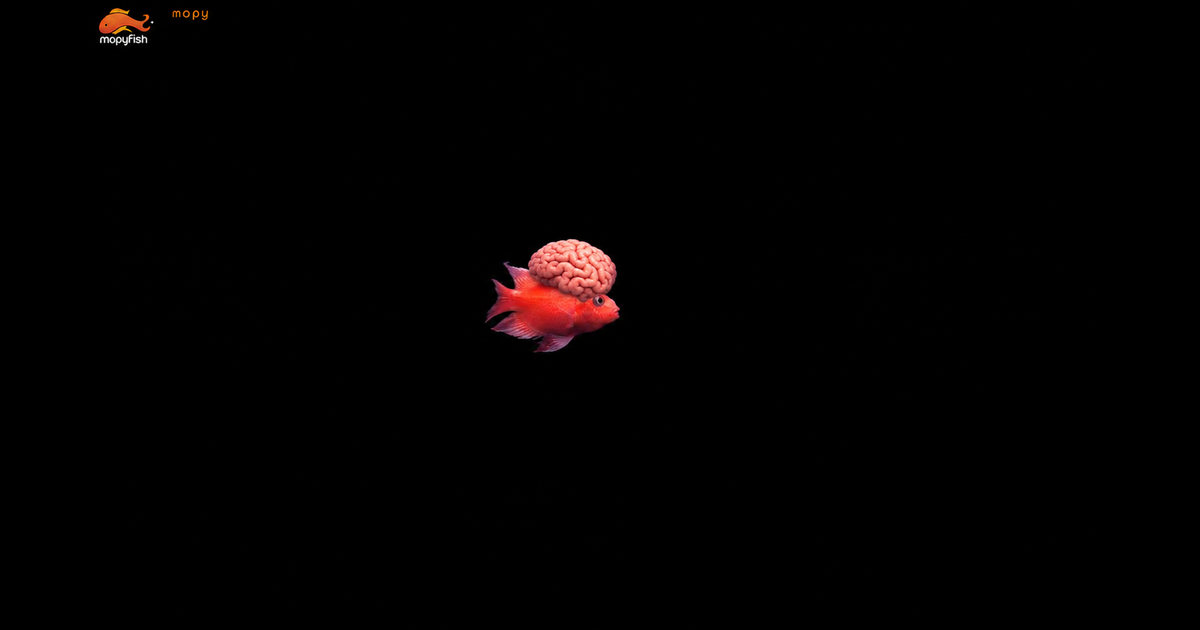
While dissecting the inner workings of MOPy Fish, I was very curious to find out how its "brain" works. It's literally got a brain file named brain.dat, and the information menus inside the screensaver are full of buzzwords on advanced AI and learning.
Contents
Intelligence claims in MOPy Fish
If you think the AI hype is bad today, take a look at the claims made about the virtual fish inside its own menus:
- The virtual fish is NOT a toy; it's a pet fish that is alive and sensitive.
- It has an "artificial brain" that ensures it "behaves just like" real fish (and is modeled on two named Spike and Reef)
- It's developed by "the world leader in the development of artificial intelligent life forms"
- They developed an "Artificial Intelligent brain" that allows the fish to "develop a memory", "uniquely react to the way you look after it", and "give it life-like swimming actions and personality traits that are found in real Parrot fish"
More concretely, it's promised that the fish can:
- Become unfriendly if you don't interact with it
- Sulk if not given attention within the first hour of turning on your PC
- Get bored and refuse to play
- Get aggravated or frightened
- Become annoyed and aggressive
- Become traumatized if you click it too much, act strangely, and stay that way for days if you don't leave it alone (ending up "a neurotic fish" with "SFA - Serious Fish Attitude")
- Remember how it was treated over the past 7 days and develop a behavior pattern accordingly
That's quite impressive for a fish developed in 1997 and distributed on floppy disks. But is it actually true?
The short answer: kind of true
I presented an AI agent inside the Reverse Engineering repository with the claims above, and asked it to analyze the original files. It was instructed to steelman the claims, but to remain truthful and realistic. Here's how it summarized its findings:
Short answer: MOPy Fish's "brain" is a set of animations made from photographs of a real fish, linked by fixed rules, with randomly generated numbers for variety and a few clocks and counters behind it. The
brain.datfile is tiny. It records when you last fed the fish, how many days you've visited, and whether the fish was still tired when you closed it. Nothing in the program learns, adapts to you or models a personality.Read generously, though, more of the claims hold up than you'd expect. The fish gets hungrier in stages if you don't feed it, and dies after about two weeks of neglect. It greets you differently depending on how long your PC has been on. It flinches when you tap the glass, and clicking at the right moments can make it sprint until it wears itself out and swims sluggishly for a while. It also rewards regular visits with a plant, bubbles and a thermometer. Anger, aggression and a 7-day memory have no code behind them. The program's own help text promises a "traumatized" fish if you click it too much, and the code counts rapid clicks but never acts on the count. For a 1997 screensaver on floppy disks, it's a well-made illusion of a pet with moods.
Claim by claim
Here's the breakdown on how each claim holds up:
| Claim | What the fish actually does | Verdict |
|---|---|---|
| "Develops a memory" | Between sessions it remembers three things: when you last fed it, how many days you've opened it (as points), and whether it was still tired when you closed it. Hunger keeps building while the PC is off, and a tired fish is still tired the next time you open it. | True in a narrow sense. It remembers a few facts, and one of them (tiredness) depends on how you treated it. |
| "Reacts uniquely to how you look after it" | Opening it on many different days earns rewards for the tank: a plant after about 20 days, bubbles and sound after about 40, and a thermometer with a speed control after about 60. When you last fed it changes how hungry it acts and how long it eats. Pestering it can make it sprint and then go sluggish. | A reasonable steelman: feeding, regular visits and pestering all have visible effects. They follow fixed rules, though. The fish doesn't learn. |
| "Unfriendly if you don't interact" | After a day without food it switches to a different repeating routine for each stage of hunger: a little hungry, hungry, very hungry, and starving (3 days or more). | Partly. Only feeding counts as interaction. Skipping visits or never clicking makes no difference. |
| "Sulks if not given attention in the first hour after turning on your PC" | On the first run of each day, it opens with a different routine depending on how long the PC has been on. Right after startup it picks one of several intro routines at random. After an hour or more, it does one of three greeting routines (drifting and turning, bobbing up and down, or turning and tilting its head). A hungry fish skips the greeting and goes straight to its hunger routine. | The closest literal match: how it greets you does depend on how long the PC was on. Whether any greeting looks like "sulking" is down to the animation. |
| "Gets bored and refuses to play" | After every fifth sprint, it swims across the tank at half speed or slower for at least 30 seconds. Its fins and body still move at normal speed. If you provoke more sprints before it recovers, each slowdown lasts longer, up to 10 minutes. Clicking at the right moment, while it's turning between its front view and its angled pose, can set off a sprint. | A decent match if read as tiredness. You can wear it out, and it recovers over time. "Refuses" is a stretch: it still swims, just slowly. |
| "Aggravated or frightened" | Clicking the glass startles it, though the full startle reaction happens at most once a minute. A click also cuts short whatever routine it's in and makes it move faster for a second. If you click while it's turning, it may dive and sprint off-screen. | True for "frightened": every click gets a flinch or a dart. It doesn't get more upset the more you click. |
| "Annoyed and aggressive" | The program keeps two click counts, one for quick bursts and a running total that resets after two minutes, but never uses either. Pestering it only works through the tiredness route above, and the result is a sluggish fish, not an aggressive one. | Not implemented. The help text describes the feature in detail and the click counting is built, but nothing acts on it. |
| "Remembers the past 7 days and develops a behaviour pattern" | It keeps no day-by-day history. It only knows the last feeding time, the number of days visited and any tiredness left over. How worn out it got earlier isn't remembered. | False as stated. |
| "Alive and sensitive", "AI brain" | Neglect has real consequences: after 15 days without food it shows a dead fish, and feeding won't bring it back. Pestering has short-term ones (sprinting, then tiredness). Underneath, it's a set of animations made from photographs1, linked by fixed rules, with randomly generated numbers for variety plus some timers and counters. | Tamagotchi-level "alive", with a bit more reactivity than it first seems. No AI in any technical sense. |
Fatigue is stored in the brain
The brain.dat file really just stores a few numbers and some timestamps: The amount of MOPy points at the last run, the time of the last feed, the last load and save times, and slow-motion seconds and level. It has no history, no direct counts of how you treated the fish, and no weights.
Now, the slow-motion seconds and the level values are actually interesting: it turns out they act together to form a fatigue mechanic. Two of the 33 animation reels show as fast dart moves (number 9 and number 33), and every time those reels are triggered, an "escalation counter" goes up.
This counter moves from 1-10, and each level corresponds to a specific amount of "level" and "slow-motion seconds":
| Escalation | 1 | 2 | 3 | 4 | 5 | 6 | 7 | 8 | 9 | 10 |
|---|---|---|---|---|---|---|---|---|---|---|
| Level | 1 | 1 | 1 | 2 | 2 | 2 | 3 | 3 | 3 | 3 |
| Seconds | 30 | 120 | 180 | 240 | 300 | 360 | 420 | 480 | 540 | 600 |
When an animation reel starts, the amount of pixels the fish moves on the X/Y axis is divided by "Level + 1". So for escalation 1-3, the speed is halved. Then it goes to 1/3. And lastly to 1/4 speed.
The animation frame rate stays the same throughout. So the fish flaps at normal speed but drifts left or right across the tank more slowly.
In practice: too many quick dashes tire the fish out, and it recovers over time. User clicks in the tank that land at the right time in an animation sequence can trigger the darting moves, causing it to speed up for a clip, and this in turn lowers the movement speed of the free-swimming fish for a while afterwards.
Slow-motion seconds count down, second by second. When it reaches 0 (which assumes no new events escalated the fatigue before then), the whole thing resets and the fish is no longer acting "fatigued".
Because the seconds counter and level are stored in the brain, this "fatigue" can carry over from session to session. If you close MOPy Fish while it's moving slow, it will also move slow when you open it again, until the slow-motion seconds counter is back down to 0.
The annoyance feature that never was
The help text that ships inside the program is quite specific about what happens if you pester the fish:
By clicking very quickly on it, you can chase your fish around the tank. Don't over do it though, or your fish may become traumatized and start acting strangely. If this happens you must leave your fish alone to settle down, otherwise the condition could be aggravated and last for days.
If you aggravate or frighten it, it will chase round the tank faster, and as a result become annoyed and aggressive - and can even end up as a neurotic fish.
MOPy Fish help text (MOPYPLAY.EXE)
The code does half of this. Every click in the tank updates two counters: one counts clicks that come less than a second apart, and the other keeps a running total of those quick clicks and resets after two minutes. That's exactly what you'd need to spot "clicking very quickly" and "over doing it". But nothing ever reads either counter. Not the fish program, and not the other programs that came with it (the screensaver launcher, the points collector and the uninstaller).
The other half is missing. brain.dat has no field that could hold a condition that lasts for days, and there's no trauma, neurotic or SFA mode anywhere in the code, the animations or the settings. There's no unused "angry" animation either: apart from one special-purpose frame, every frame belongs to a clip. The tap reaction is called FRALEFTCLICK1, and the "1" hints that more were planned, but no other click clip exists.
The code does have a behavior state that nothing ever switches to. It plays the fish's routine at the fastest animation speed and ends after the clip where clicks make the fish follow them up or down has played three times. It could be a leftover of the over-clicking mode, but nothing links it to the counters.
Conclusion
The "Artificial Intelligent brain" is just a few counters and timestamps in a tiny file, and no learning is taking place. Some of the claims, like the 7-day memory and the aggression, have no code behind them at all.
But the parts that do exist work well. Hunger keeps building while your PC is off, and you can tire your fish out so much that it still appears sluggish the next day. And MOPy Fish does feel surprisingly alive. That so little code achieves it shows how clever its designers were.
The over-clicking feature was clearly planned, though. The help text describes it in detail, and the code that counts the clicks is there. Only the part that acts on the count is missing. My guess is that the deadline came before the code did. We've all been there.
I'm quite impressed with MOPy's brain, and glad I got to look inside it.
- Al Fasoldt, newspaper column (The Syracuse Newspapers, 16 November 1997). "The animation that gives Mopy such striking realism was created from 1 million color photographs of a goldfish." The fish is a blood parrot cichlid, not a goldfish, and the program ships 662 frames. Column
I'm Simon Ahm, and I take on contract work. If this post is close to what you're working on, I can help: consultedo.com.