Out of the Drain: How I Brought MOPy Fish Back With AI
10 million people downloaded MOPy Fish, then pulled the drain for good. I fished it out of the 1997 binary with AI agents and rebuilt it for the browser.
November 23, 2026
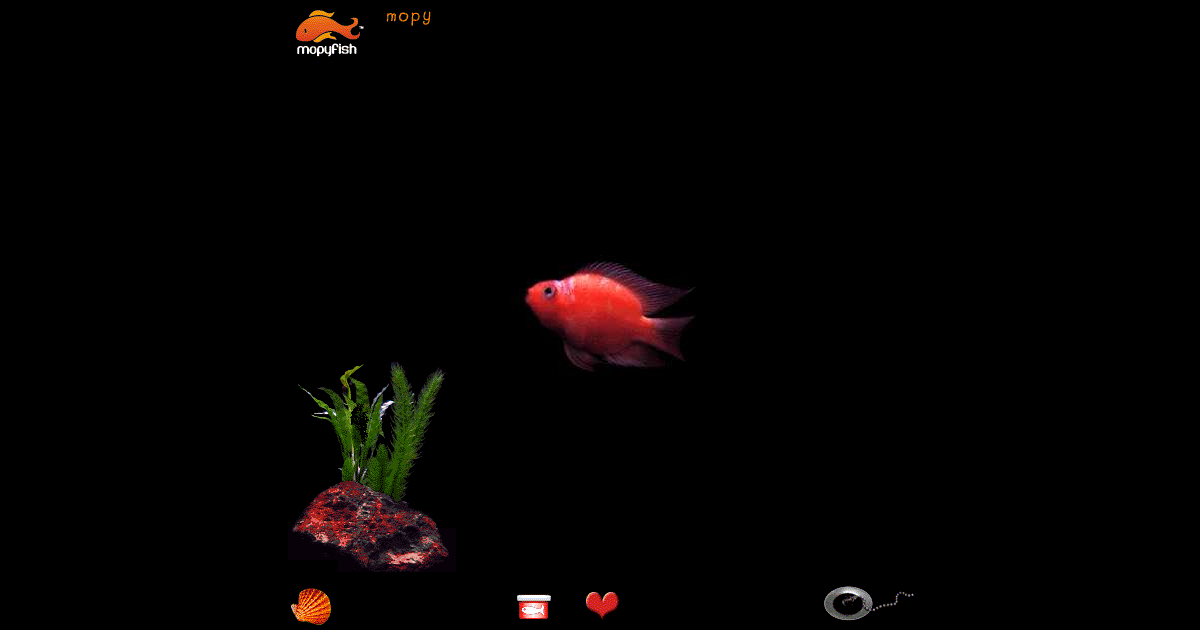
Some time in the late 1990s, a bright red fish was living on my family's computer. I'd watch it, feed it, and click on it until it spazzed out. One time, I forgot to feed it for too long, and it died... Luckily, I could bring it back with the push of a button.
That fish was MOPy Fish. And in a fit of nostalgia, I gave it a second life in 2026. The result is a full, unofficial, re-implementation that lives in the web browser - on your computer, phone, smart TV, or whatever you want to turn into a fish tank:

This post describes why I decided to do this, how I approached it, and what I learned along the way.
Contents
Motivation
I started this project for myself. I remembered MOPy from my childhood and wanted to see him swim again, on the devices I use today.
While doing my research, I realized how popular MOPy Fish used to be - and that other people might like to see their fishy friend again as well. It's even mentioned in the Book of Guinness World Records (2001) as the most downloaded cyberpet ever - more than 10 million downloads by the release of the book.

Bantam Books, New York, United States, 2001. ISBN: 0-553-58375-1
One day, each of those millions of people clicked the drain to exit the screensaver for the last time, and MOPy has been stuck down there ever since.
So I decided to fish him out - but this time it took more than a simple button press to revive him. Legacy apps made in 1997 don't usually play well with modern operating systems. Just ask any one of the many enterprises still relying on decades-old legacy software. And MOPy Fish was no exception: it needed to be rebuilt for the modern world, and that meant reverse engineering it.
I've always been drawn to reverse engineering. Professionally, I've spent years integrating with systems that have no documentation, or no API at all. But my experience with binaries was limited to some Android disassembly and NOP-ing out a jump or two in my youth (for educational purposes, of course). I'd never taken a complete program apart.
So this became the perfect excuse to dive into reverse engineering with AI agents.
Setting the goal
While this is just a side-project, I find that even curiosity and fun are enhanced by working towards something.
For this project, the goals were clear:
- Had to be a faithful re-implementation of MOPy Fish
- It needed to run in a regular web browser
- I was to have fun with it
Staying faithful to the original would hopefully help me stay on track and manage the scope effectively. No messing with the graphics, movements, behavior, or anything else that would put the nostalgia at risk. Even if it's tempting to teach an old fish new tricks.
Starting with a goofy target, like MOPy Fish, is a great way to keep things fun. But trust me, the disease of seriousness can infect even the most silly of ventures. So watch out, and stay playful!
What I started with
The target was MOPy Fish v1.9a, and the copy I worked from came out of the archived Bill Greganti's Mopyfish Hacks site.
Bill's site also contains other useful information, such as screenshots of the application running, descriptions of its behavior, as well as the history of how the app came to be.
MOPy Fish also has a Wikipedia page, which turned out to contain some myths about MOPy I had the pleasure of debunking.
And of course I had my own childhood memories of how the MOPy Fish application looked and acted. As fallible as those can be.
Harness and Agent Tooling
I orchestrated agents through Paseo, which manages sessions across both Claude Code and OpenCode and allows hand-offs between them. All agents ran on a dedicated vibe-coding VPS I have set up, allowing me to control them from both my laptop and phone.
Two repositories were created for this project:
- mopy_fish_re
- mopy_fish_web
All the reverse engineering happened inside mopy_fish_re. The resulting spec and relevant extracted resources (e.g. graphics) were copied to mopy_fish_web for the re-implementation.
The agents in the RE project were provided with access to REA (Reverse-Engineer Anything) - an MCP that provides tools and instructions for breaking down and analyzing a piece of software, extracting the resources, and producing a detailed spec.
The agents in the WEB project were provided with the Playwright MCP, which allowed them to spin up a browser and interact with the re-implementation as they were building it.
Static vs. dynamic analysis
Static analysis picks apart and analyzes a binary file - control flows, strings, imports etc., while dynamic analysis means the software is examined while it's running. You usually want to do both: the static analysis gives you a high level overview of the program, and allow you to make informed hypotheses about how the different parts work. The dynamic analysis then allows you to test those hypotheses in practice, and trace execution paths as they're triggered.
I limited myself to static analysis of the binary, for three reasons:
- I wanted to see how far I could come with just static analysis.
- I was doing this, partly, to test a new dedicated vibe box setup, where stability is a main priority. That means not running strange executables on it.
- I'm using Linux everywhere, and this is a 16-bit Windows binary. Probably possible via Wine, but it'd be quite hacky, and running RE tools in that context sounds... interesting.
A remote sandbox would have taken care of 2 and 3, and is something I'm actively looking into. It was overkill for this application, so I decided against letting that slow me down.
I'm generally a fan of not introducing complexity until necessary. In this case, I managed without it.
REA limitations
I sadly learned that REA doesn't currently handle 16-bit Windows NE (New Executable) files. REA 6.8.0 rejected the MOPy Fish binaries outright ("unsupported NE executable in MZ image"), so the agent moved on after its first attempt.
Looking into this, it turns out REA only offers 32-bit x86 for raw input, even though the Ghidra program it calls underneath supports 16-bit x86 and even has an NE loader1. REA's documentation confirms this as being explicitly left out of their scope:
recognized NE, LE, and LX headers are explicitly unsupported
REA docs, ghidra-dos.md
REA's tools never got to analyze MOPy Fish, but its skill file still gave the agents a method: turn the request into a checklist of questions, keep a ledger tying each finding to its evidence and confidence, and separate what was observed from what was inferred2. So I kept it in.
Luckily, the AI agents built their own tooling and moved forward anyway. They used basic objdump and wrote custom parsers in Python for the binaries, and used those tools with enough rigor to produce a useful result.
But I was left wondering - why didn't the agents just call Ghidra directly, circumventing REA's hardcoded limitations? Turns out my orchestration agent jumped to the conclusion, that if REA couldn't handle it, Ghidra was out, and made that policy:
"REA's `open_binary` on MOPYFISH.SCR / MOPYPLAY.EXE / IMAGES.DLL → `target_unavailable` … Do not retry; do not switch to runtime tooling."

"Decided: No Ghidra/REA binary session for these NE files (provider rejects them). Use Python parsers + objdump."
And I mean... Fair enough. Not sure we'd want agents to constantly question the outputs of the tools we explicitly hand them, and try to get around their limitations.
But this is a good reminder, that an MCP - calling an underlying tool - may very well have limitations, that the tool itself doesn't have.
Either way, the homemade RE lab the agents had spun up was producing results: a spec was forming, and MOPy assets were showing up. I continued on.
Models and Subscriptions
I used an OpenCode Go subscription inside of OpenCode, mainly running Muse Spark 1.3 and DeepSeek V4.1 Flash. For Claude Code, I used Opus 5.5 with Haiku 5.5 subagents, and for a single review task I tried out the newly released Fable 5.2.
I do find it both interesting and entertaining to watch people "token-maxxing" with frontier models. But the demand I see, from startups and large enterprises alike, is for agentic development and AI use that holds up over the long term and stays efficient, financially and otherwise.
Cost and client-preferences aren't constraints on this fish-project, but I do find that constraints help creative problem solving. And there's something enjoyable about seeing how much I can squeeze out of combining a $20 Claude Pro and a $10 OpenCode Go subscription. Experimenting hands-on with many different models also gives me a much better picture of where AI stands, than if I relied only on a single frontier provider for everything.
I've also been very impressed with Muse Spark for general software development. It's fast, very competent at tool use, and for projects where the Contributor mode is appropriate (when there's no issue with Meta training on your use of the model), it's basically unbeatable on price and usage limits. It's also very confident in approaching reverse engineering tasks - unfortunately, it's not very good at it...
Reverse Engineering isn't for every model
I naively let Muse Spark 1.3 kick off the RE effort. Extracting a binary file and analyzing it sounds like burning tokens with a flamethrower, so using a cheap model was tempting - I didn't want to risk my momentum by triggering usage limits before even getting started.
It developed tools, analyzed the binary, extracted resources, and made confident remarks about the inner workings of MOPy Fish. Confident, but wrong.
Reviews by Fable 5.2 and Opus 5.5 revealed multiple wrong conclusions in Muse's work: sometimes the exact opposite of what the code actually does. A misreading of the drawing routine, for example, produced a string of confidently wrong claims about the graphics. Fable 5.2 was likely overkill for this use case, but it was released (with promo credits) during this little experiment, so I gave it a go. Had I used Opus 5.5 for the analysis from the beginning, such review likely wouldn't have been necessary at all.
In fairness, Muse did build a functioning foundation: about 4,300 lines of parsers for the 16-bit binaries and their resources, which passed the Claude reviews with flying colors. Its tooling was solid and used by Claude moving forward. It just wasn't capable of correctly interpreting the output. So it remains a useful model for orchestration and development, but not suitable for reverse engineering.
Looking at the benchmarks for agentic reverse engineering, this should have come as no surprise. Do your research, folks:
| Model | SRE Bench (Vals)3 | SRE-Bench (paper)5 | SRE-Bench (unconstrained)6 |
|---|---|---|---|
| GPT-6 Astra | 56.87% | 5.55 / 6 | 88.0% |
| GPT-6.1 Sol | 50.76% | - | - |
| Gemini 4 Argon | 44.27% | - | - |
| Claude Opus 5.5 | 33.59% | - | 82.1% |
| Claude Opus 5.5 (CVP)4 | 21.76% | - | - |
| (...) | (...) | (...) | (...) |
| Muse Spark 1.3 | 3.82% | - | - |
| (...) | (...) | (...) | (...) |
| DeepSeek V4.1 Flash | 0.76% | 0.85 / 6 | - |
At the time of writing, there are still no comparable benchmarks of Fable 5.2.
While the top GPT models show better performance on the reverse engineering benchmarks, I doubt it would make much of a difference for this screensaver. So I stuck with Opus 5.5 for the analysis after the Muse fiasco. With mechanical work automatically handed off to Haiku subagents, it remained a very efficient setup in regards to both speed and usage limits.
I'm curious to see how well Muse could have done, had I set up a full end-to-end testing pipeline from the beginning, allowing it to compare a re-implementation with a running version of the original. Could it have caught its own mistakes and corrected them? Stronger models are getting better and better at one-shotting tasks, but given the right workflows and tools, the less powerful models can often deliver comparable end-results. I might run that experiment later.
Poking around in the binary
I wanted to look at the resources and logic that had been extracted from the binaries.
There were many questions in my head about the inner workings of MOPy Fish, so I asked them - to my RE agents.
It helped me uncover quite a lot of things:
- Dissecting a Virtual Fish Brain: the AI brain MOPy's menus promise, checked claim by claim against the code.
- The Reel Life of MOPy Fish: all 33 animation reels and what the fish does in each.
- Going Through the Motions: How MOPy Fish Swims: the 15 swim programs that move the fish around the tank.
- Finding the MOPy Fish Cheat Codes: six typed cheat codes, and how people hacked their way to MOPy points in the 90s.
- How MOPy Fish Generates Aphrodisiac Passwords: where the password for aphrodisiac fish food comes from.
None of this was strictly necessary for the re-implementation. The agents would have found all of it on their own, without me poking around. But I'm not here to do the strictly necessary things; I'm here to revive a virtual fish. Exploration is fun, and I think having fun is the best way to learn: it keeps me engaged and curious.
Re-implementation - being the "human-in-the-loop"
The re-implementation started off smooth enough.
The spec, graphics and other assets were copied from the mopy_fish_re into the mopy_fish_web repository.
And then I started out carefully:
(...)
build the following:

M1 — Foundation: static skeleton, boot, timed clip playback, full-window canvas.

Goal: a page that opens the tank, boots per spec, and plays the start clip on
a loop in a full-window canvas. No interaction, no movement, no sound yet.

Stack (non-negotiable): vanilla HTML/CSS/JS only.
(...)
Plus some references to the spec and assets, along with explanations copied straight from the RE agent.
It worked flawlessly! There he was, my MOPy, once again floating in the dark waters of my monitor. He wasn't moving much, of course. But I'd gotten him back from the drain: now it was a question of bringing him to life.
So my next prompt requested an autonomous fish, that included scheduler transitions, movement, states, input, persistence, and audio/text - all elements described and defined by the spec from the RE project.

This time he moved! Swimming around, alive once again. He somehow wasn't quite himself, though... He didn't really move away from the left side of the screen. And he didn't react to feeding at all.
But maybe that was always the case? This whole evaluation now rested on vague childhood memories. But other things were clearly broken too: placeholder rectangles instead of the seashell, plant, and other graphical elements.
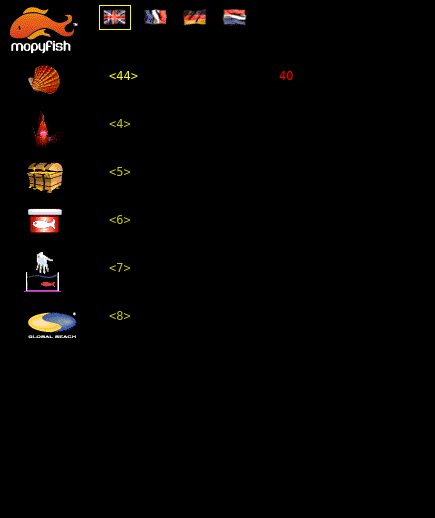
The menu contained placeholder numbers instead of the strings:
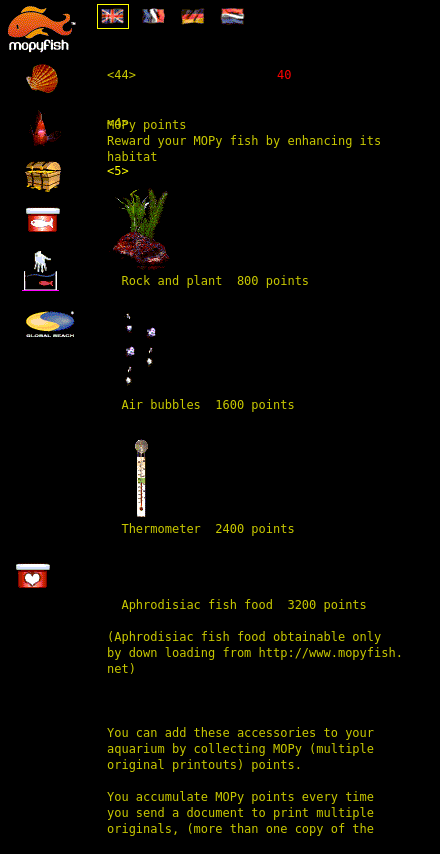
And the dialogs that should have been hidden, like the aphrodisiac fish food greeting, were shown alongside the menu contents:
There were lots of little things clearly wrong. Some things were maybe wrong - at least it seemed like bad UX, or just didn't feel right to me. It also turned out, that there were things wrong, I hadn't noticed at all - like the fact that the text color was yellow, and should have been teal. Relying on childhood memories isn't an ideal approach to debugging!
The grown-up way to do this would have been to run the original, record what it does, and make the agents match it, so "done" is something testable instead. For MOPy Fish, I didn't bother. Getting 16-bit Windows running felt like homework, and my childhood memory was kind of the spec anyway.
I was starting to question the rationale from earlier about "avoiding complexity" and limiting myself to static analysis, though. Imagine how smooth things would run, if an agent could just execute the original screensaver and observe it? Compare it with the re-implementation, spot the issues, and initiate fixes all by itself?
Instead, I was now the unwilling "human-in-the-loop" while fully aware that I could have replaced myself. What's more, I was mediating between two teams of agents: The RE team and the WEB team. Each had access to only their own repository, and I was the human in the middle relaying messages back and forth... For. No. Good. Reason.
But hey, lesson (re-)learned: mono repos often make a lot of sense when doing Agentic Development. Full separation like this would only really make sense, if I was trying to do a clean-room re-implementation: but that's not a constraint I'm working under - the logic comes straight from the reverse engineering, and the art, sounds and help text are the originals. In the end I just gave the WEB agents access to the RE repository, and let them look for themselves.
Being caught in the loop wasn't all a waste, though. Seeing what broke - in what order, and what it took to fix it - was informative. You could theoretically gain the same insight by studying the logs of an agent doing it all for you, but... Would you?
MOPy is back
And in the end it worked out: MOPy is back, and providing exactly the sense of nostalgia I was looking for.
Should the perfectionist-bug bite, the final step would be to run MOPy Fish in a VM, under Windows 95 or NT, and compare them side by side. But I'm satisfied for now - and hope others will find the revival of MOPy Fish just as satisfying as I do.
That leaves just one loose end: I reverse engineered a copyrighted program and put its original graphics back online, without asking anyone for permission. Whether that will get me into trouble depends on who owns MOPy Fish today, and that turned out to be a story of its own: Who Owns a Dead Fish: Is MOPy Fish Off the Hook?
- Ghidra source code (release 12.1.4, the version used in this project). The x86 language definitions include "Intel/AMD 16-bit x86 Real Mode" and "Intel/AMD 16-bit x86 Protected Mode", and the
NeLoaderclass loads "New Executable (NE)" files. Language definitions · NE loader - REA agent skill, "Plan broader investigations" (rea-agents-6.8.0). A staged workflow: a checklist of questions with the evidence each answer needs, a finding ledger with confidence and remaining unknowns, and a final pass marking each question answered, partially answered or unresolved. The same file requires every conclusion to "distinguish observations, inferences, and unknowns". SKILL.md
- SRE Bench, Vals AI leaderboard (updated 5 Nov 2026). Share of 262 private binaries fully reverse engineered (all six graded tasks passed), cyber safeguards on. Muse Spark 1.3 was run at Max effort. Models are ranked by this column. Results
- Claude Opus 5.5 run through Anthropic's Cyber Verification Program (CVP), listed separately on the Vals AI leaderboard. Same benchmark and metric as the standard Opus 5.5 row. Results
- SRE-Bench: "The Next Challenge for Agentic Cybersecurity: A Realistic, Contamination-Free Reverse Engineering Benchmark" (Columbia University, arXiv 2608.11469). Public-setting table from the paper: mean graded tasks passed per binary, out of 6, cyber safeguards on. Only eight models were tested, and most models in this table were not among them. GPT-6 Astra's figure covers only the 181 binaries it didn't refuse. Paper · Results
- SRE-Bench, unconstrained setting (same paper). Pass@1 with no cyber safeguards and no budget limit, run in each provider's own internal configuration. Not comparable with the other columns. Paper
I'm Simon Ahm, and I take on contract work. If this post is close to what you're working on, I can help: consultedo.com.