Who Owns a Dead Fish: Is MOPy Fish Off the Hook?
MOPy Fish was made for HP, but HP never owned it. The company that did was dissolved in 2023, so the fish most likely belongs to the King now.
November 23, 2026
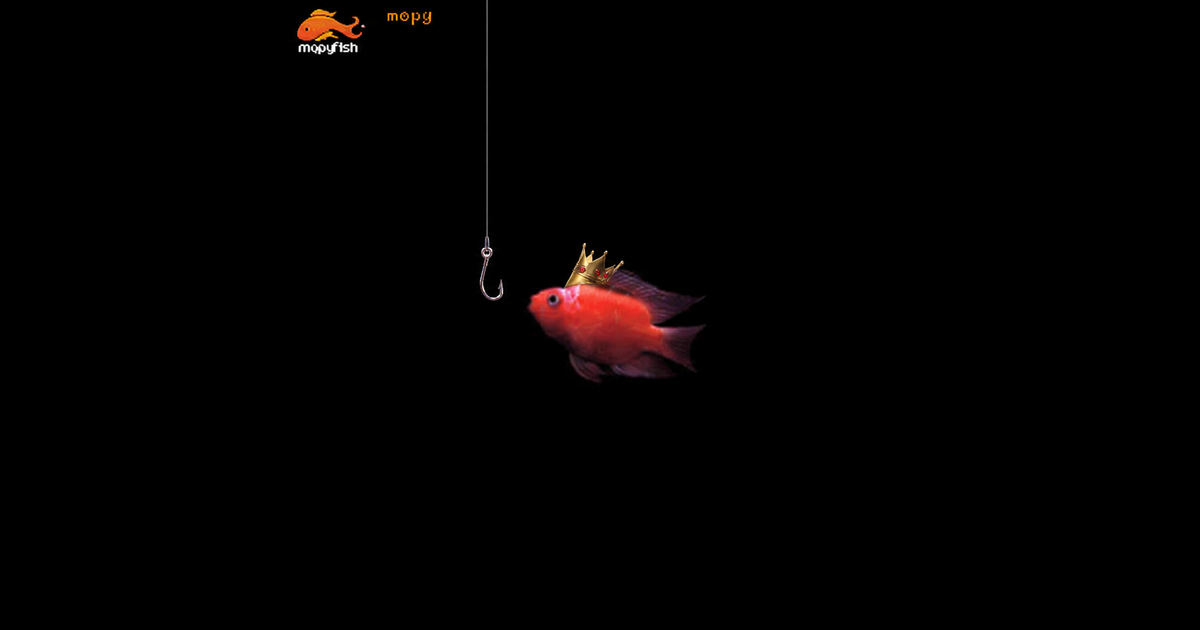
Bringing MOPy Fish back to life meant reverse engineering a binary, extracting its original graphics and publishing a faithful copy on the web. So before releasing it, I wanted to know: who owns MOPy Fish today, and are they likely to sue me?
I'm not a lawyer, and this isn't legal advice. It's what I found, my sources for it, and how I decided to act on it.
Contents
Made for HP, owned by someone else
MOPy Fish was made by Global Beach, a London digital agency founded by Clive Jackson in 1993. It was released in late 1997 for Hewlett-Packard, as a promotion for printing "Multiple Original Printouts" instead of photocopying. Al Fasoldt's newspaper column from 16 November 1997 already offered it as a free download, and specifically described it as a public relations stunt for the German branch of HP.
That meaning of MOPy comes from the fish's own help text: "MOPy. It means producing Multiple Original Printouts." It adds: "The only thing as sharp as an original printout is another original printout." The term started inside HP, whose 1995 patent used "mopy" for "multiple original copy".
Since HP's name is all over it, I naturally assumed HP owned it. After HP split in 2015, that would make HP Inc. the likely owner, as they're the half that kept the printers.
That assumption didn't last. I had the RE agent search the original files for any copyright and license text, and the license agreement in the v1.9a installer is clear:
(c) Copyright 1997-2001 Global Beach Limited
The Software is owned by Global Beach Limited
So HP paid for the fish and put its name on it, but Global Beach kept the copyright. At least according to the license that it shipped with.
The owner is dead too
Global Beach Limited was dissolved in March 2023. Its sister company, Global Beach Group Limited, was struck off a week later.
Under UK law, when a company is dissolved, everything it still owns passes to the Crown as bona vacantia; ownerless property (Companies Act 2006, s.1012). So if Global Beach still held the rights in 2023, MOPy Fish now technically belongs to the King.
Global Beach is reported to have been acquired by speakTECH, a Californian design firm, in October 2009, and speakTECH was later bought by the IT consultancy Perficient. If that deal had included the UK company, the fish could belong to Perficient today. They probably don't care much about technically owning a virtual fish, and likely don't even know it was part of the package.
The filings at Companies House show it's not the case anyway. In Global Beach Limited's accounts for the year to January 2010, a few months after the deal, its parent company is still Global Beach Group Limited, the UK holding company. The company was still trading, with over a million pounds owed to it, and the accounts were signed by Clive Jackson as director. From 2016, when the register of controlling persons started, Clive is listed as controlling both Global Beach Limited and Global Beach Group Limited, right up until they were dissolved. Iain Lewis, MOPy's technical director, stayed on the board until 2021.
Clive Jackson has said he sold Global Beach in 2008. The filings still show him as director after the 2009 deal, and as controlling person of both companies from 2016 until they were dissolved. The public record doesn't say what the deal covered. It may have been the agency business rather than the companies themselves.
So whatever speakTECH bought in 2009, it wasn't the company that owned MOPy Fish. The accounts can't rule out that the copyright itself was sold on separately, but nothing I can find points that way.
The most likely chain of ownership is then: Global Beach Limited from 1997 until it was struck off in March 2023, and the British Crown since then. The Crown doesn't chase 1990s screensaver art.
There's technically one loose end. A dissolved company can be restored within six years (s.1024, s.1030), and if that happened, the copyright would go back to it. So until around March 2029, the person with the most realistic claim to the fish is probably Clive himself. So if you're reading this, Clive: please don't sue me. I'll gladly hand the revived MOPy Fish back over to you.
The name is free
The MOPy logo was filed as EU trademark 000686394. It was filed in November 1997, registered in 1999, and expired in November 2007 without renewal. A US application for "MOPY" was abandoned in 2000, and there's nothing in the UK register.
So there are no live trademarks on the MOPy name anywhere I've looked.
What's still protected
Just because the trademark expired, doesn't mean the artwork is free to use. The copyright in the 662 fish frames, the bitmaps, the sounds and the help text runs for decades more, until at least the late 2060s. That's a minimum: in the UK, copyright lasts for the author's life plus 70 years (CDPA s.12), and the fish frames were built from commissioned photographs, so the term depends on how long the people who made them live. My web version serves those files unchanged: otherwise it wouldn't really be MOPy Fish.
The rest is on firmer ground:
- The code. EU law doesn't protect what a program does, only the code that expresses it (SAS Institute v World Programming, C-406/10). The browser version was written from a spec of the behavior, and I am not publishing the disassembly.
- The protection. Nothing was cracked. The points and unlock system was re-implemented, not bypassed. And while I document how the special codes are generated, the website where these could be used to unlock the aphrodisiac fish food hasn't existed for years.
- The license. It bans reverse engineering, but the only company that could enforce those terms no longer exists.
The law lets you learn how software works
The MOPy license is governed by English law. UK law gives anyone lawfully using a program the right to observe, study and test how it works while loading, running or displaying it, to work out the ideas and principles behind it (CDPA s.50BA). A contract term that tries to forbid this is void (s.296A). EU law has the same rule in the Software Directive (Art. 5(3) and Art. 8), which also applies in Cyprus, where I live.
The limit: decompiling code is only allowed for interoperability (s.50B; Directive Art. 6). Recreating a program isn't interoperability, so the browser version was written from a spec of the behavior and the disassembly stays private. This right to study how software behaves is what this series explores.
So, am I off the hook?
Not strictly. The assets are still under copyright, and I don't have permission to use them.
But in practice, I'm comfortable with the risk. The likely owner is the British Crown, holding the leftovers of a dissolved company. The only person who could realistically bring the company back is its founder, and I'd much rather hear what he thinks of the project than worry about it. The trademark is long dead. Lawsuits over free fan projects almost always start with an ignored takedown notice, not out of the blue.
So I made sure nobody has a reason to complain, and made it easy to reach me if they do anyway:
- No HP logos displayed anywhere in the app.
- No ads, donations or sales pitches on mopyfish.com.
- A clear note on the about page that the project isn't affiliated with HP or Global Beach.
- A takedown contact on that same page. If a rights holder asks, it comes down the same day.
I've also written to Clive Jackson to tell him the fish is swimming again. If he, or anyone else with a claim, wants it taken down, it comes down.
I'm Simon Ahm, and I take on contract work. If this post is close to what you're working on, I can help: consultedo.com.