Red Herrings: Myths About MOPy Fish
Wikipedia says MOPy Fish dies after three weeks of neglect and remembers a week of care. The code kills it at 15 days, and its memory of you is one timestamp.
November 23, 2026

The Wikipedia page for MOPy Fish makes a few claims about how the fish behaves. After reverse engineering the screensaver with AI, I could check them against the code. Four of them don't hold up, and neither do several claims from Global Beach's own website and a 1997 newspaper column.
Everything below comes from static analysis of MOPy Fish v1.9a: the agents read the binary and wrote a spec, and nothing was executed. The Wikipedia quotes are from the September 2024 revision of the article.
Contents
It remembers a week of care
Wikipedia says the fish "can remember how it has been treated over the last week".
The only thing the fish saves about how you treated it is the time of the last feed. The save file, brain.dat, contains only points, timestamps and slow-motion counters. No clicks, no earlier feeds, nothing that could hold a week of history. I go through the whole file in AI in 1997: Dissecting a Virtual Fish Brain.
Aggressive after five days, depressed after ten
Wikipedia says it "will, for example, become aggressive if not fed in five days, and may act depressed when starved for as many as ten days."
The code has five hunger states, chosen by the hours since the last feed. The last one starts at 72 hours (3 days) and lasts until the fish dies. Nothing changes at day 5 or day 10.
It dies after three weeks
Wikipedia says: "If the MOPy fish is neglected and not fed for three weeks, it will fall sick and die." That comes from the official website, mopyfish.net: "After three weeks it will die and float to the top of the tank."
The fish dies after 360 hours without food, which is 15 days. There's no sick state on the way: the fish stays in the last hunger state until then.
A baby fish for 20 points
Wikipedia's list of things to buy with MOPy points starts with a baby fish for 20 points. The description on Screensavers Planet lists baby fish too:
You must feed and play with your pet fish to keep it alive and happy. Whenever you send documents to your computer printer, you will collect MOPy (Multiple Original Printouts) points that you can exchange for accessories such as rocks and plants, bubbles, a thermometer and baby fish.
Screensavers Planet
The code unlocks extras at exactly 800, 1,600, 2,400 and 3,200 points. The agents searched the program code and all its text for a baby fish or a 20-point unlock, and found neither.
New toys are coming
The "new toys for mopy" page on mopyfish.net asked for your name and email address, to keep you "informed of the release dates" of "fun new toys" for the tank. The picture next to the form is captioned "new tank funiture" [sic].
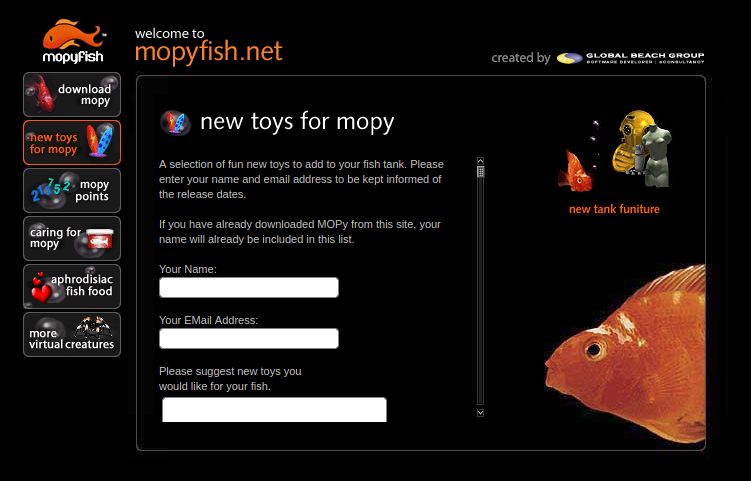
I haven't found an example of that furniture anywhere. The aphrodisiac fish food seems to be the only official extension ever made.
The fish is called MOPy
It was very common to call the fish itself "mopy", and Global Beach did it too. The menu on mopyfish.net reads "download mopy", "new toys for mopy" and "caring for mopy".
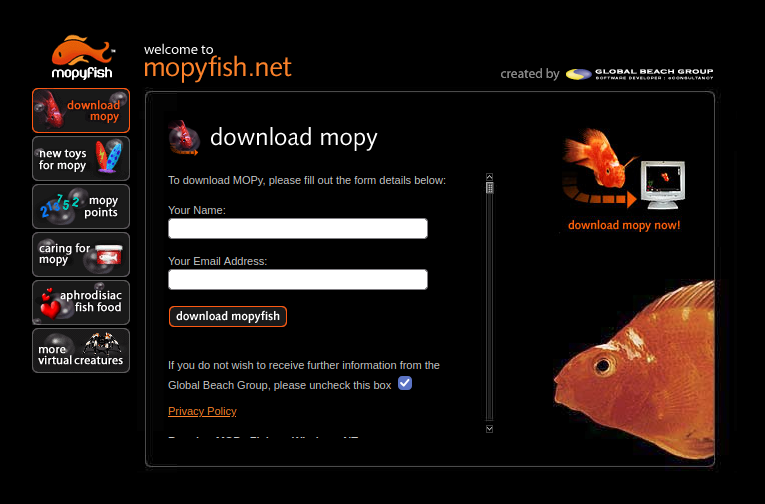
The fish has no set name, though. The screensaver has a name field at the top of the screen, and you can call your fish anything, as long as it's in lowercase letters. I still name mine mopy.
The program is called "MOPy fish"
Wikipedia titles its article "MOPy fish" and uses that spelling throughout. The program itself spells it with a capital F: "MOPy Fish". The care page on mopyfish.net writes "the MOPy fish", which may be where Wikipedia's spelling comes from.
Made from a million photos
In November 1997, Al Fasoldt wrote about MOPy Fish in his column for The Syracuse Newspapers:
Mopy is an animation, as you might guess. But unlike nearly all other animations you can play on your PC, which are composed of hundreds or perhaps even thousands of separate frames, the animation that gives Mopy such striking realism was created from 1 million color photographs of a goldfish.
Al Fasoldt, The Syracuse Newspapers, 16 November 1997 (column)
The program ships 662 frames, right in the "hundreds" the column ruled out. The files can't tell how many photos were taken before those 662 were picked, so a million may be true of the photo shoot. It isn't true of the animation.
The million comes from Global Beach. The program's information pages say the fish "was photographed over 1 million times" (quoted in full below).
It's a goldfish
The same column calls MOPy a goldfish throughout. A reader's letter, printed below the column, corrected it:
If the photograph which accompanies the story is an actual photo of "Mopy pet" I feel compelled to inform you that he is not, as you mentioned several times in your article, a goldfish, but is actually a member of the Cichlid (pronounced sick-lid) family called a "Bloody Parrot".
Jeff VanBuren, letter printed below the column
The letter adds that a blood parrot is a cross-breed, and that it "relishes the opportunity to dine on common goldfish".
The column didn't need a reader to get this right. The information pages inside the program name the fish twice. The first page says MOPy was "developed to mimic the behavior of a real Parrot Fish", and the page on how the program was made says:
The natural fish is a Parrot Fish (hoplachus psitticus) that was photographed over 1 million times to provide its realistic look.
MOPy Fish v1.9a, information pages, "How the program was made"
The Latin name is misspelled. Hoplarchus psittacus is a real species from South American blackwater rivers, sold to aquarists as the parrot cichlid. It isn't the blood parrot from the letter, a hybrid first bred in Taiwan around 1986. So the program and the letter name two different fish, and the files can't tell which one was photographed. Neither is a goldfish.
It never repeats itself
The column also promised a fish that never does the same thing twice:
Like any real fish -- and unlike any animations you've ever seen -- Mopy swims and cavorts in endless realism, never repeating any of its behavior patterns in exactly the same way, always reacting in subtle variations to your mouse movements.
Al Fasoldt, The Syracuse Newspapers, 16 November 1997
The program does try. Random numbers pick the next reel, and most of the swim programs generate random amounts when they start, so the same reel rarely moves the same way twice. But the frames inside a reel are fixed, and some reels have no random element at all.
The sprint is one of them. Reels 6, 28, 29 and 33 always follow each other, and their swim programs (82, 80 and 84) generate no random numbers. The fish dives, darts off the left edge and zips across the screen the same way every time, only starting from wherever it happened to be. Several other reels move the fish by a fixed amount on every step, or not at all.
Clicks and food bring it back
The column also explained how to bring a dead fish back:
If you forget to feed it, Mopy turns glum, and if you neglect it for more than a few weeks, the fish goes belly-up and floats to the top of your screen. (A few coaxing clicks and a dash of fish food will bring Mopy back to life.)
Al Fasoldt, The Syracuse Newspapers, 16 November 1997
Neither works. While the fish is dead, the feed button doesn't update the time of the last feed, and clicks never touch it. To bring MOPy back, press F2 and click "Bring MOPy Fish to life". The only other way is the clock trick below.
Where the myths come from
Most of these myths come from Global Beach themselves, which is less damning than it sounds. Their help pages describe the fish they set out to build. The code is the fish they shipped.
The information pages inside the program promise a fish that "will remember how it has been treated over the past 7 days", gets agitated after 5 days without food, sulks after 6-10 days and dies after two weeks. The "caring for mopy" page on mopyfish.net says much the same, but with three weeks:
You will find that it will respond to you (mouse clicks), although sometimes it may get bored with playing - that's fish for you! If you aggravate or frighten it, it will chase round the tank faster, and as a result it will become annoyed and aggressive or neurotic. Contrary to popular belief, this fish species does have a memory span. It will remember how it has been treated over the past 7 days, and develop a behaviour pattern accordingly.
Regular feeding will ensure that your fish thrives. This species is happiest when fed once a day, and it will start to remember when it is feeding time (if you feed it more than once a day, you may upset its feeding pattern). If not fed for 5 days it gets agitated and after 6-10 days it starts to sulk.
If you neglect your fish, it gradually becomes sluggish and will fall sick. After three weeks it will die and float to the top of the tank.
mopyfish.net, "caring for mopy"
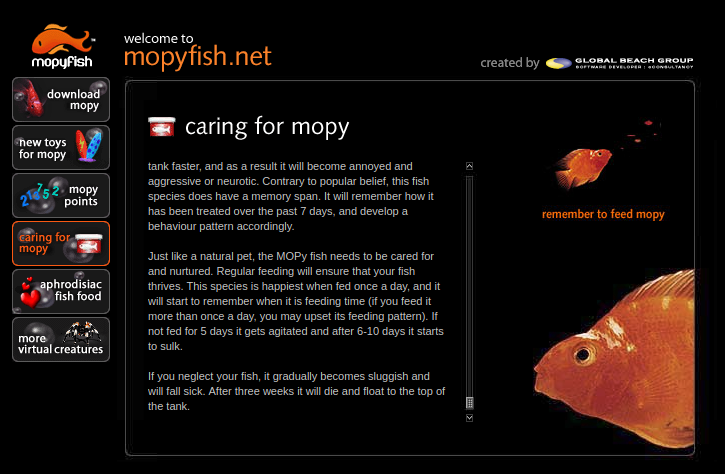
Wikipedia took its description from those pages, so it inherited the same gap. Against the code, most of the page doesn't hold up:
- Clicks can make the fish sprint, and too many sprints make it swim slowly for a while. Nothing makes it annoyed, aggressive or neurotic: the program counts your clicks but never uses the count.
- The fish stores only the time of the last feed, so it can't learn when feeding time is or have a feeding pattern to upset.
- A neglected fish doesn't get sluggish. Only sprinting slows it down. Neglect moves it through the hunger states until it dies at 15 days, with no sick state on the way.
I don't think anyone was overselling. The program counts your clicks and never uses the count, which looks a lot like the start of the annoyance feature the help pages describe. As I wrote in AI in 1997: Dissecting a Virtual Fish Brain, my guess is the deadline came before the code did.
The 7-day memory and the 5-day and 6-10-day stages are covered above.
What Wikipedia gets right
The password for the aphrodisiac fish food is issued automatically at 3,200 points. I cover how it's made in How MOPy Fish Generates Aphrodisiac Passwords.
And you can bring a dead fish back by changing the computer's date. The program doesn't save whether the fish is dead. It works that out again from the last feed time every time it starts. Set the clock to less than 15 days after the last feed, and the fish is alive again. Set it to before the last feed, and the program treats it like a fresh install: alive, and 26 hours hungry.
Wikipedia also gets the name right: MOPy stands for "Multiple Original Printouts". The fish's own help text says so: "MOPy. It means producing Multiple Original Printouts." The term is older than the fish. HP's 1995 patent already used "mopy" for "multiple original copy".
I'm Simon Ahm, and I take on contract work. If this post is close to what you're working on, I can help: consultedo.com.